
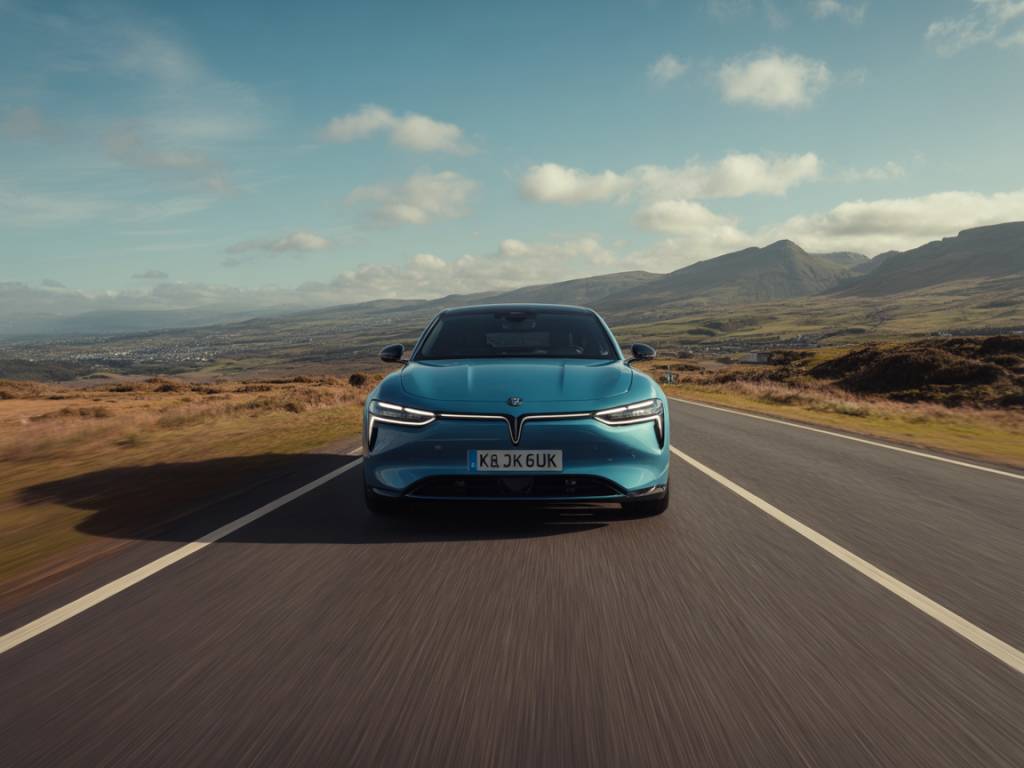
On paper, most new electric cars today look like they’ll do “up to 250–300 miles” on a charge. Out on the M1 in February with the heater on and a headwind, that story can change very quickly.
If you’re choosing your first (or next) EV for UK roads, the official range figure is just a starting point. What really matters is what the car will do on your commute in January, on the school run in the rain, or on a Friday-night dash down the M4.
Let’s unpack how to compare real-world range figures properly so you don’t end up with an electric car that looks great in the brochure but stresses you out at 5% battery on the A303.
Why the official range figure is only half the story
Every new EV sold in the UK carries an official WLTP range. It’s better than the old NEDC numbers, but it’s still a lab test. Real cars on real roads don’t drive like lab cycles.
The WLTP range tends to be optimistic for UK use because:
- Average speed is low – WLTP mixes low and medium speeds and doesn’t spend much time at a true 70 mph motorway cruise.
- Temperature is “nice” – The test is run in mild conditions. We don’t live in a climate-controlled lab; we live in Britain with drizzle and cold snaps.
- No proper accessories load – Air con, heated seats, demister, wipers on constant… these are barely reflected.
The pattern I see in testing is simple:
- On UK mixed driving, many EVs manage around 65–80% of WLTP.
- On a long, steady motorway run, especially in winter, you can drop to 50–65% of WLTP.
So the question isn’t “What’s the WLTP range?” but “What slice of that range can I actually count on for my kind of driving?”
Start with your real life, not the spec sheet
Before getting lost in kWh and kilowatts, anchor your choice to how you actually drive. A few key questions to answer:
- What’s your regular commute, door to door? Is it 18 miles on A-roads, or 70 miles of mostly motorway?
- Can you charge at home or work? A driveway with a 7 kW home charger changes the maths completely.
- How often do you do long trips? A monthly 250-mile family visit is a different problem from daily 40-mile commuting.
- What are your non-negotiables? For some drivers, arriving with 10% battery feels fine; for others, anything under 30% is stressful.
Once you’ve answered these, you can translate manufacturer claims into a realistic, usable range target for your usage rather than an abstract number.
Key numbers that matter more than the headline range
The trick to comparing EVs fairly is to get beyond the marketing headline and into three underlying numbers:
- Usable battery size (kWh)
- Real-world efficiency (miles per kWh)
- Buffer you’re comfortable with (reserve %)
Let’s look at each.
1. Usable battery size
Many manufacturers quote the gross battery capacity – but you can’t use all of it. The battery management system protects the cells by keeping a buffer top and bottom.
What you want to find is the usable capacity. You’ll often see this in independent tests or specialist databases as something like “77 kWh gross / 73 kWh usable”. That usable figure is what really dictates how far you’ll go.
2. Real-world efficiency (mi/kWh)
Think of this as the EV equivalent of mpg. It tells you how many miles you get for each unit of energy. For everyday comparison in the UK, miles per kWh is more intuitive than kWh/100 km.
Real-world motorway efficiencies I commonly see:
- Small, aero-friendly EVs – around 3.5–4.0 mi/kWh at 65–70 mph in mild weather.
- Family crossovers/SUVs – 2.7–3.3 mi/kWh in similar conditions.
- Large, heavy or performance EVs – 2.2–2.8 mi/kWh on the motorway.
3. Your personal buffer
Most drivers don’t want to arrive at a charger on 1%. Nor should they – in winter, that last 10% can evaporate quickly if traffic slows and you’re running the heater and demister.
Decide what feels safe to you:
- Many EV drivers plan trips assuming they’ll use 10–80% of the battery.
- More cautious drivers work on 20–80% or even 20–90%, especially in winter.
Once you’ve picked a buffer, you can work out a realistic “comfortable” range instead of the fantasy brochure number.
A simple method to estimate real UK motorway range
Here’s the basic maths I use when testing cars on UK motorways.
Step 1 – Find usable battery capacity
Dig into independent tests or manufacturer technical data to find the usable figure. Let’s say it’s 70 kWh usable.
Step 2 – Choose a realistic efficiency
For a mid-sized family EV in the UK cruising at 70 mph:
- Summer mixed driving: maybe 3.5–4.0 mi/kWh.
- Motorway-heavy: 3.0–3.3 mi/kWh in good conditions.
- Winter motorway: 2.3–2.8 mi/kWh is more realistic.
We’ll pick 2.6 mi/kWh to simulate a typical winter motorway run.
Step 3 – Multiply battery by efficiency
70 kWh × 2.6 mi/kWh = 182 miles from 100% to 0% in those conditions.
Step 4 – Apply your buffer
If you only want to use 10–80% of the battery on long runs (70% of capacity):
182 miles × 0.7 ≈ 127 miles of comfortable winter motorway range.
The brochure might say “up to 270 miles WLTP”. On a cold Friday evening on the M6, what you effectively have is a car you’ll happily drive about 120–140 miles between rapid charges without anxiety.
That’s the number you should be comparing across models.
How to use independent UK tests and data
You don’t have to guess all of this. Several UK and European sources publish instrumented or carefully logged tests:
- What Car? and Autocar – often run standardised UK routes and publish their own range results.
- EV Database – not UK-specific, but it offers useful estimated real-world motorway and city ranges.
- Independent YouTube testers – look for channels that show full trip data, speeds and weather, not just “it felt fine”.
- Owner forums and Facebook groups – real drivers in your area will tell you what they actually see at 70 mph in January.
When comparing different sources, watch for:
- Average speed – 60 mph and 70 mph produce very different ranges.
- Temperature – 5°C with rain is nothing like 20°C and dry.
- Elevation and terrain – long, flat motorway vs hilly A-roads in Wales or Scotland.
If you find two or three credible sources all lining up around a similar “motorway range at 70 mph”, you can use that as your realistic benchmark.
UK-specific factors that can kill (or boost) range
The UK has a few quirks that particularly affect real-world EV range.
1. Motorway vs A-roads
Wind resistance rises quickly with speed. That means:
- At 70 mph on the M1, many EVs sit in their least efficient zone.
- At 50–60 mph on A-roads, range per kWh improves noticeably.
I routinely see the same car do 30–40% more range on a gentle A-road route than on a fast motorway stretch, in the same weather.
2. Winter, rain and HVAC use
Cold batteries are less efficient, and heating an EV uses a significant chunk of energy, especially in older models without heat pumps.
Expect in typical UK winter use:
- 10–20% drop in mild cold (5–10°C).
- Up to 30–40% drop on short trips at close to 0°C with heavy heater use.
Rain adds rolling resistance and often heavy traffic; wipers, lights and demisters are all drawing power. Don’t underestimate the impact of a dark, wet January evening on range.
3. Traffic and stop–start driving
Unlike petrol cars, EVs don’t mind stop–start as much. In fact, for many models:
- Slow urban driving can be more efficient than 70 mph motorways thanks to regenerative braking and lower aero drag.
This is why a car with a disappointing motorway range can still be completely adequate for a London or Manchester commute heavy on 30–40 mph sections.
Matching real-world range to your use case
Now let’s translate all this into something practical for different types of UK drivers.
Urban and suburban commuters (under 30 miles a day)
If you can charge at home and your daily usage is modest:
- You can live very happily with an EV that has a real 120–150 miles mixed range.
- Official WLTP of around 180–220 miles is usually fine.
- Focus more on efficiency and running costs than chasing huge batteries you’ll rarely use.
Mixed commuting with some motorway (30–80 miles a day)
For a 50–80 mile round trip, often including a stretch of M1, M4, M6 or M25:
- Look for cars with a real 170–220 miles mixed range.
- This usually corresponds to 240–300 miles WLTP.
- Aim to cover your daily round trip using no more than 50–60% of the battery in winter.
Regular long-distance drivers
If you’re often doing 150–250 mile single journeys, range and charging speed both matter:
- Prioritise EVs with a real winter motorway range of 180–220 miles between 10–80% charge.
- That often means WLTP figures in the 300–350+ miles bracket.
- Also check: can it hold 100–150 kW+ charging for a good chunk of the curve?
A car that can only do 130 miles between comfortable motorway stops but adds 200 miles in 20–25 minutes can still be perfectly workable if you’re happy to build those breaks into your journey.
Don’t ignore charging: range isn’t everything
Real-world usability is a triangle: range, charging speed and network quality. If one side is weaker, another has to be stronger.
When comparing cars for UK use, look at:
- Peak DC charge rate – 100 kW vs 250 kW sounds impressive, but…
- Charging curve – How long does it hold high power? A car that does 150 kW for 3 minutes then drops to 60 kW is less useful than one that sits at 120 kW for 20 minutes.
- From–to figures – Many realistic road trips are planned around 10–80% charging. Look for tested times for that window.
For UK motorway use, I consider the following a practical minimum today:
- 10–80% in under 35 minutes on a 100 kW+ charger.
If a car has modest range but very strong charging performance, your real-world journey time might be closer to a longer-range but slower-charging rival. That’s where test reports and real owner feedback beat the spec sheet.
How to compare two EVs side by side for real-world range
Let’s say you’re torn between two family EVs with similar prices but different specs. Here’s a simple workflow.
Step 1 – Find usable battery
- Car A: 60 kWh usable
- Car B: 75 kWh usable
Step 2 – Look up real-world efficiency data (focus on motorway)
- Car A: 3.1 mi/kWh at 70 mph in mild weather, around 2.6 mi/kWh in winter tests.
- Car B: 2.7 mi/kWh at 70 mph in mild weather, around 2.3 mi/kWh in winter.
Step 3 – Calculate winter motorway range (0–100%)
- Car A: 60 × 2.6 ≈ 156 miles
- Car B: 75 × 2.3 ≈ 173 miles
So despite the larger battery, Car B only gains you around 10–15% more winter motorway range.
Step 4 – Apply your comfort buffer (10–80%)
- Car A usable trip range: 156 × 0.7 ≈ 109 miles
- Car B usable trip range: 173 × 0.7 ≈ 121 miles
Now compare that to your regular long trips. If your typical leg between planned stops is 100–110 miles, both cars work. Car B’s benefit is marginal – so you may lean back to Car A if it’s cheaper, more efficient in town, or has better charging performance.
Practical checks to do before you sign
Once you’ve narrowed your shortlist, a few simple checks can save you an expensive mistake:
- Test drive on your actual route – Ask for an extended test and drive your real commute or typical motorway stretch. Reset the trip, note your mi/kWh and multiply by usable battery.
- Ask owners in your region – Forums and Facebook groups for that model in the UK will quickly tell you “it does X miles at 70 in winter”.
- Simulate your worst-case day – Cold, wet, heavy traffic, lots of lights and heater use. Will the car still cover your needs with a safety margin?
- Check your local charging map – If you’re on the outskirts of a charging desert, you’ll value a bigger real-world range more.
Real-world range is less about believing or disbelieving a number and more about translating that number into your daily and monthly routines.
Once you know how to strip an EV’s specs back to usable battery, realistic efficiency and your own comfort buffer, the picture becomes much clearer. That’s when you stop chasing the biggest headline range and start choosing the car that genuinely fits your UK roads, your habits and your budget.