
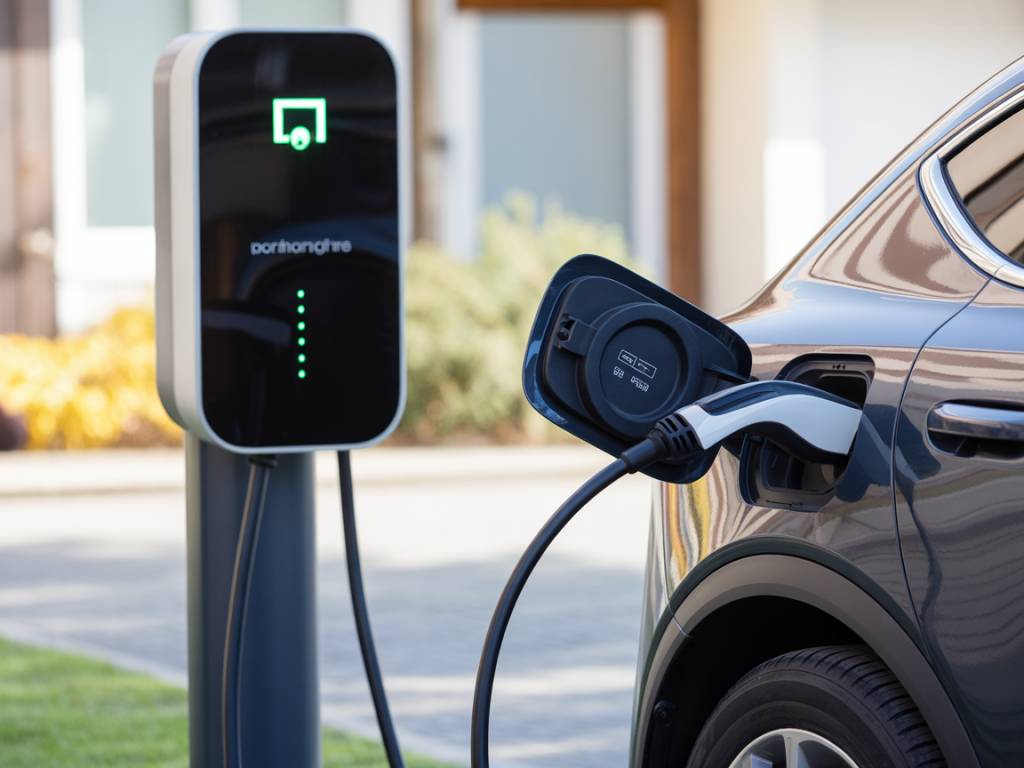
If you’ve just bought your first EV, you’ve probably heard three pieces of advice on repeat: “Charge at home, use off-peak electricity, get a smart charger.” All sound good in theory. But what does that actually look like in a real UK driveway with a normal fuse board and a busy family schedule?
Let’s strip the jargon away and go through how to set up smart charging at home so you pay less, charge faster, and don’t fry your electrics in the process.
What “smart charging” really means (and what it doesn’t)
Smart charging is simply this: your charger or car automatically chooses when and sometimes how fast to charge, based on rules you set (price, time, solar, grid limits), instead of just blasting power as soon as you plug in.
Practically, a smart setup can:
- Shift most charging to cheap, off-peak hours (often overnight).
- Avoid tripping your house electrics by limiting power when other appliances are on.
- Use solar surplus, if you have panels, instead of exporting it for pennies.
- Let you set a target charge level and departure time so the car is ready when you need it, not 5 hours too early.
What it doesn’t do by magic:
- It won’t charge faster than your car’s onboard charger or your home supply can handle.
- It doesn’t “save the battery” in any miracle way beyond what you can already do with basic settings (like not charging to 100% every day).
- It doesn’t make paid public charging cheap – that’s a different battlefield.
Think of smart charging as a disciplined driver who knows your electricity prices, your routine and your house wiring, and quietly optimises everything in the background.
Home charging basics: what you actually need
Before getting clever with smart tariffs and apps, you need the right hardware in place. For most UK homes, you’re choosing between:
- 3‑pin “granny” cable (2–3 kW): Fine in an emergency, painfully slow for regular use, and not ideal for long-term high-load use on a standard socket.
- Dedicated wallbox (typically 7.2–7.4 kW): What most EV owners end up with. About 25–30 miles of range per hour for many modern EVs.
If you’re serious about cutting bills and charging faster, a 7 kW smart wallbox is the sweet spot for most households:
- Fast enough to go from, say, 20–80% overnight even on large-battery EVs.
- Usually supports smart scheduling, app control and load balancing.
- Works on a standard UK single-phase 230 V supply with a 32 A circuit.
A rough install cost in the UK is still typically in the £800–£1,200 bracket all-in (hardware + standard installation), though it varies with cable runs, groundworks, and fuse board upgrades.
How to cut your charging bills with off‑peak tariffs
This is where smart charging earns its keep. Domestic electricity in the UK can easily cost 28–35p/kWh at the time of writing. Smart or EV-specific tariffs can drop that to 7–15p/kWh off‑peak if you’re flexible about when you charge.
Let’s put real numbers on that.
Say your EV uses about 18 kWh/100 km (roughly 29 kWh/100 miles):
- At 30p/kWh: £5.40 per 100 km
- At 10p/kWh night rate: £1.80 per 100 km
If you drive 12,000 miles (19,000 km) a year, that’s the difference between roughly £1,000/year and £330/year in “fuel”. That’s why messing around with a few settings in your charger app is worth your time.
A smart charging routine typically looks like this:
- You tell the app your off‑peak window (e.g. 23:30–05:30).
- You plug in when you get home, any time.
- The charger waits until off‑peak starts, then runs flat-out until your target state of charge or end of cheap period.
If your commute is short, you’ll often only need 2–3 hours of cheap charging overnight – even when starting from a relatively low battery.
Charger app vs car app: who’s in charge?
This is where many first-time EV owners get stuck: the car app can schedule charging; the wallbox app can schedule charging. Use both, and they can fight each other and refuse to start.
Use one “brain” only. You have two main options:
- Let the charger manage everything
You set a simple daily or weekly schedule in the charger app and leave the car’s charge schedule off (or set to “charge immediately”).
Pros: Works with any EV, ties into your tariff, often better at load management.
Best if: You change cars later, or have multiple EVs. - Let the car manage everything
You set departure times and charging windows in the car, and leave the charger in “dumb” mode (always on).
Pros: Often nicer interface, knows your real battery %, can include battery preconditioning.
Best if: You have a single EV and like keeping it simple.
Personally, I prefer letting the charger do the tariff optimisation if your provider supports direct integration. For example, some UK energy suppliers and charger brands talk to each other so the charger automatically chases the cheapest half-hours overnight without you doing anything beyond the initial setup.
How fast can you really charge at home?
“Faster” at home doesn’t mean “motorway rapid charger fast”. It means “fast enough overnight without paying for more hardware than you can actually use”.
Several things limit your real charging speed:
- Your car’s onboard AC charger
Most EVs in the UK support 7.4 kW AC single-phase. Some older or cheaper models are limited to 3.6–6.6 kW. A few support 11 kW AC, but that requires three-phase power – rare in UK homes. - Your home’s main fuse rating
Commonly 60 A, 80 A or 100 A. A 7.4 kW charger draws about 32 A on its own. If you have an older house with a 60 A fuse, your installer may recommend either limiting the charger to ~20–25 A or upgrading the supply (if your DNO agrees). - Other appliances running at the same time
Showers, ovens, electric hobs, tumble dryers – they all add up. This is where smart charger load balancing helps.
In practice, a standard 7 kW home charger will usually give you:
- ~30–35 km of range per hour on a small EV or efficient hatchback.
- ~20–25 km of range per hour on a larger SUV or less efficient model.
Over a 4–5 hour off‑peak window, that’s typically 100–150 miles of added range, which covers most weekly commutes easily.
Avoiding trips and blown fuses: load balancing and safety
One of the common fears – and a valid one – is “Will my EV charger trip the whole house when someone puts the kettle and microwave on?” It can, if installed badly or set up without limits. That’s what load management is for.
Modern smart chargers often provide:
- Dynamic load balancing: A small sensor (CT clamp) on your main supply measures total current draw. If the house load climbs (cooker + shower + heat pump), the charger automatically reduces its charging current to keep you under a safe limit.
- Configurable max current: Your installer can set the charger to never exceed, say, 24 A instead of 32 A if your main fuse is small.
- Thermal and RCD protection: Built-in safety cut-outs as required by current wiring regulations.
The result: your car might charge a bit slower for an hour while everyone’s showering and cooking, then ramp back up later in the night when the house is quiet.
If an installer offers to fit a “dumb” charger without any discussion of supply capacity or load management, ask more questions.
Real-world example: first EV, typical UK semi
Let’s take a practical scenario.
You’ve bought a family EV with a 60 kWh usable battery and typical real-world consumption of 18 kWh/100 km. You live in a semi-detached house with:
- 100 A main fuse
- Gas heating, electric oven, induction hob
- Standard 7.4 kW smart wallbox
- EV tariff offering 4 cheap hours at 10p/kWh overnight
Your weekly pattern:
- Commute: 40 km/day, 5 days a week (200 km)
- School runs and errands: 80 km/week
- Total: ~280 km/week
At 18 kWh/100 km, that’s about 50 kWh/week.
On a 7 kW charger, you need roughly 7 hours of charging to replace that. If you charge twice a week during the 4-hour cheap window, that’s 8 hours total – enough with margin.
Cost per week at 10p/kWh: £5.00
Cost per week at 30p/kWh: £15.00
Yearly fuel bill difference: ~£520 saved, just by using smart off‑peak charging and a couple of schedules.
Smart charging with solar: using your own energy first
If you have solar PV, smart charging becomes even more interesting. Instead of exporting surplus electricity for 5–15p/kWh, you can feed it directly into your car and effectively “fuel” it for that value.
Most solar-aware smart chargers offer a few modes:
- Solar only: The car only charges from surplus solar above a certain threshold. Great in summer, too slow or inconsistent in winter.
- Solar + top-up: Priority to solar during the day, then uses cheap night-rate grid power to finish the job.
- Balanced mode: A mix of solar and grid to maintain a target power.
A very practical approach for UK weather:
- On weekdays, rely on night-time off‑peak charging – simple and predictable.
- On weekends or sunny days at home, enable surplus-solar charging so the car “sips” from the roof instead of the grid.
Don’t obsess over being 100% solar-powered; the real win is stacking off‑peak rates + solar surplus. That two-step approach usually beats chasing pure solar-only charging and ending up short.
Battery health: smart settings that actually matter
Most of the battery scare stories online ignore one thing: modern EV battery management systems are better than the average human at looking after cells. That said, a few smart charging habits do help long-term health and wallet:
- Avoid leaving the car at 100% for days. Use smart charging to finish close to your departure time, especially for long trips.
- Daily target of 70–80% is enough for most commutes. Only go to 90–100% when you actually need the extra range.
- Use scheduled pre‑conditioning while plugged in. Heating or cooling the car on grid power is easier on the battery and much nicer on a frosty morning.
- Don’t panic about occasional fast charging. Home AC charging is already “gentle”; focus on reasonable limits, not micromanagement.
Most of these options are either in the car’s app or your smart charger’s settings. Spend 10–15 minutes once to set them up, then leave them alone.
Practical setup: a step-by-step plan for first‑time owners
To pull this all together, here’s a simple order of operations that works for most new EV drivers in the UK:
- Check your home supply.
Look at your main fuse rating (often labelled 60 A / 80 A / 100 A). Take a photo and show it to your installer. Ask explicitly about load management. - Choose a smart charger, not just a box with a socket.
Prioritise:- Dynamic load balancing support
- Integration with UK tariffs or at least good scheduling
- A decent, updated app (check recent reviews, not brochure screenshots)
- Switch, or at least price up, an EV‑friendly tariff.
Even moving from 30p to 20p/kWh off‑peak can make a clear difference. Check standing charges too; cheap nights can be offset by a high daily fee. - Decide who’s the “brain” – car or charger.
Pick one scheduler. Turn the other to “charge immediately” to avoid conflicts. - Set a sensible default routine.
For example: “Charge between 23:30 and 05:30 on weekdays, target 80%.” That alone handles 90% of normal life. - Use favourites or presets for trips.
Many chargers and cars let you save a “trip mode” – e.g. charge to 100% the night before a holiday. Use that instead of changing your daily settings every time. - Check your first month’s bills.
Make sure the off‑peak window and the charging sessions line up. If you’re still doing a lot of peak charging, tweak timings or your routine.
Smart charging headaches to avoid
A few common pitfalls I see repeatedly with first-time EV owners:
- Stacking schedules: Car says “start at 01:00”, charger says “only allow between 02:00 and 05:00” and nothing actually happens. Simplify.
- Forgetting to plug in: Sounds obvious, but if you rely on scheduled charging, missing a night can ruin the next morning. Habit helps – plug in as soon as you get home.
- Ignoring firmware updates: Smart chargers are basically outdoor computers. Occasional bugs are part of the deal; updates often fix them and add features, including better tariff integration.
- Over‑speccing the charger: Paying extra for 11 kW hardware when you only have single‑phase supply is pointless. You’ll still be capped at ~7.4 kW.
Why it’s worth getting this right early on
Settling into a good smart charging routine in the first few weeks of EV ownership pays off for years:
- Your “fuel” cost per mile drops sharply compared with both ICE cars and public rapid charging.
- You reduce the chances of nuisance trips or overloading your home wiring.
- Your battery is quietly looked after via sensible charge limits and timings – without you having to think about it every day.
- You can genuinely treat the car like your phone: plug in at home, wake up charged, ignore the drama.
Home smart charging isn’t about gadgets for the sake of it. It’s about turning your driveway into the cheapest, most convenient “petrol station” you’ll ever use. Once it’s set up properly, the clever part is how quickly you forget it’s even there.