
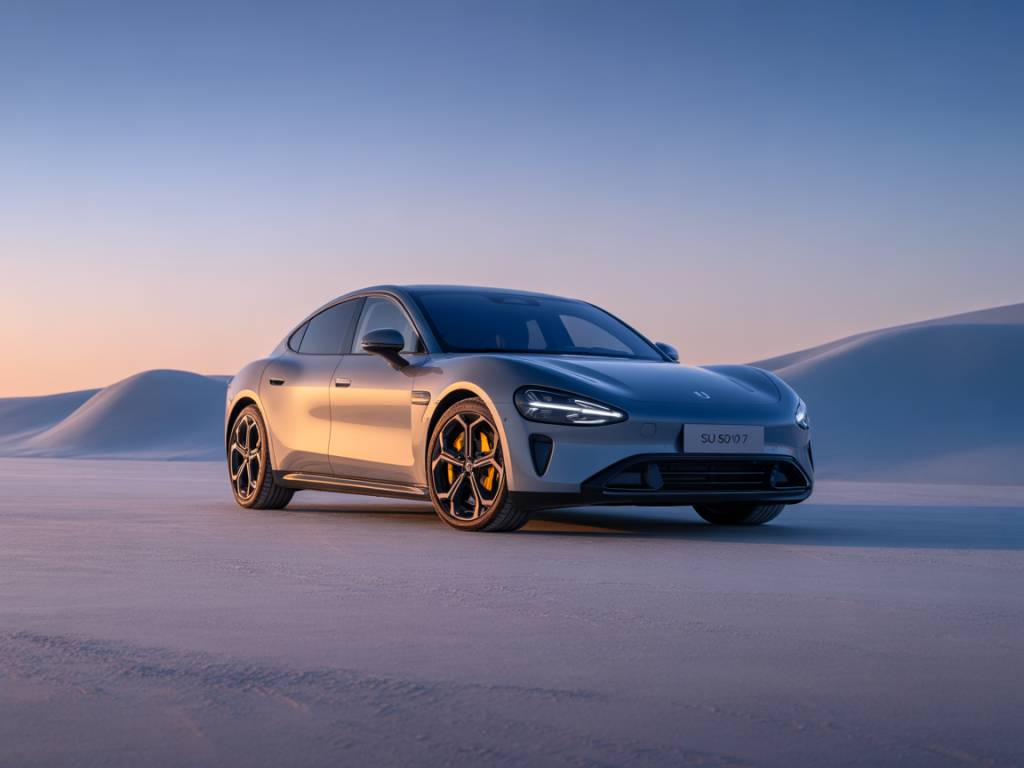
Xiaomi SU7: what UK and European drivers really need to know
If you only know Xiaomi for budget smartphones and connected gadgets, the idea of a Xiaomi-badged electric sports sedan might sound like a side project. It isn’t. The Xiaomi SU7 is a full-frontal attack on the Tesla Model 3, BYD Seal and Hyundai Ioniq 6 – with performance figures that poke into Porsche Taycan territory, at Chinese prices that are frankly brutal for the competition.
But specs and launch hype in China are one thing. What matters if you’re reading this from the UK or Europe is simple: what is this car really, how does it behave in the real world, and does it have a realistic future on our roads?
Let’s break it down in the most practical way possible: size, performance, efficiency, charging, comfort, tech, and – crucially – what the ownership picture might look like if and when it comes to Europe.
Positioning: what kind of car is the Xiaomi SU7?
The SU7 is a low, wide electric sports saloon. Think “electric grand tourer” more than family hatchback. On paper and in the metal, its closest reference points are:
- Tesla Model 3 – similar mission (electric sedan, tech-forward), but the Xiaomi is larger and more upmarket in feel.
- BYD Seal – another Chinese electric sports saloon, but the SU7 aims more at premium tech and Porsche-style image.
- Hyundai Ioniq 6 – aerodynamic, efficient electric saloon; Xiaomi undercuts it strongly in China.
Key dimensions (Chinese-spec SU7):
- Length: ~4,997 mm
- Width: ~1,963 mm
- Height: ~1,455 mm
- Wheelbase: 3,000 mm
So we’re not in Model 3 territory for size – we’re edging towards a Tesla Model S footprint at a Model 3 price point. That matters for comfort and practicality, but also for weight and efficiency.
Powertrain and performance: how fast is it really?
Xiaomi launched the SU7 in several flavours in China. Exact European specs, if the car comes here, may differ slightly, but the overall picture will be similar.
The main current versions are:
- SU7 (single motor, RWD)
Rear-wheel drive, around 220 kW (≈295 bhp). 0–100 km/h in roughly 5.2 s. - SU7 Max (dual motor, AWD)
All-wheel drive, around 495 kW (≈664 bhp). 0–100 km/h in about 2.8 s.
The numbers leave very little room for doubt: the Max is squarely in super-saloon territory. It’s quicker than a Model 3 Long Range and into the same time bracket as serious performance EVs costing vastly more.
What do early real-world tests in China say?
- Acceleration feels brutal in the Max – repeated third-party tests confirm sub-3-second 0–100 km/h runs on good tarmac.
- RWD version is more than quick enough – for everyday use it’s closer to a “warm” rather than “hot” EV, but still quicker than most ICE saloons.
- Power delivery is smooth and predictable – testers report progressive throttle mapping rather than “all or nothing” drama.
From a practical, UK-usage point of view, the RWD model is already ample. The Max is overkill unless you just like the idea of frightening your passengers on slip roads – which, to be fair, is a perfectly valid hobby.
Battery, range and efficiency: should you trust the numbers?
As usual with Chinese-market EVs, the headline range figures are given on the CLTC cycle – far more optimistic than WLTP, and a different galaxy from real-world motorway range in winter.
The SU7 uses two main battery packs:
- Standard pack – around 73–75 kWh (LFP, 400 V architecture), up to ~700 km CLTC.
- Long-range pack – around 94 kWh (NMC, 800 V architecture), up to ~830 km CLTC.
Translating CLTC to a realistic European mixed-use expectation:
- Take roughly 60–65% of CLTC to approximate WLTP.
- Then knock off another 10–20% for motorway-heavy, UK-style driving.
That gives ballpark figures of:
- Standard pack: ~400–450 km real mix, perhaps ~300–350 km at steady motorway speeds in poor weather.
- Long-range pack: ~480–520 km real mix, maybe ~380–430 km on motorways depending on conditions.
These are estimates, but they line up broadly with independent ranges achieved by Chinese reviewers at 110–120 km/h.
Is that good? Yes – those figures put the SU7 right in the mix with a Tesla Model 3 Long Range or Hyundai Ioniq 6, especially considering its size and performance. You won’t beat a hyper-efficient Ioniq 6 on motorway watt-hours per mile, but you’re also carrying more car around you.
Charging: living with the SU7 on long trips
On paper, charging is one of the car’s big strengths, especially for the 800 V variants.
- 400 V LFP versions – roughly in line with current mainstream EVs; think in the 150–200 kW peak range (exact figures vary by version).
- 800 V NMC versions – claimed to go from low state of charge to hundreds of kilometres of range in 15 minutes on high-power chargers.
Xiaomi talks about adding over 500 km CLTC in 15 minutes on their highest-spec pack. Translated to something less optimistic for UK life, that still likely means:
- 10–60% in around 20 minutes on a 250–300 kW charger for the 800 V models.
That’s in the same game as Hyundai/Kia’s 800 V cars and the best of the current crop of fast-charging EVs. The limiting factor in Europe would not be the car but the availability of genuinely high-power, well-maintained chargers – a familiar story.
The practical takeaways if it comes here:
- Motorway trips with one quick 15–25 min stop to cover 400+ km look very achievable.
- To exploit the full 800 V advantage, you’ll need access to the faster end of the public charging network (IONITY, Gridserve high-power, etc.).
Interior, comfort and practicality: tech show or usable car?
Xiaomi leans heavily on its consumer electronics DNA inside the SU7. The cabin is dominated by screens and software – but the surprise from early reviews is that the basics (seats, materials, driving position) seem largely nailed too.
Main interior features (China-spec):
- 16.1-inch central touchscreen with 3K resolution.
- 7.1-inch digital instrument cluster.
- AR head-up display on higher trims.
- Panoramic glass roof on many versions.
- Physical buttons and scroll wheels remain for key controls (volume, drive modes, etc.), which is a relief.
Space-wise, the 3,000 mm wheelbase shows. There’s generous rear legroom, and the low, wide body gives a planted driving position upfront. Rear headroom is reasonable for a coupe-style saloon, but very tall passengers may brush the roof lining.
Boot space is competitive with other electric saloons. You’re not getting SUV practicality, but it comfortably handles family luggage. There’s a front trunk (frunk) too, though not as cavernous as some Tesla models.
The important bit for daily life:
- Noise levels: Chinese tests report good sound insulation, particularly at motorway speeds, with more of a “premium saloon” than “tech gadget” ambience.
- Seats: well-rated comfort, with decent lateral support on the sportier trims. Long-distance suitability looks promising.
- Ride comfort: we’ll come back to this with driving impressions, but broadly speaking, Xiaomi has gone for a slightly firm, sporty setup rather than floaty softness.
Software and connectivity: where Xiaomi plays its home game
If there is one area where Xiaomi has a clear story, it’s integration with its existing tech ecosystem. The car runs on Xiaomi HyperOS, the same general platform that powers its phones, tablets and smart-home kit.
What does that mean in practice?
- Deep phone integration: Xiaomi smartphones can effectively become “extensions” of the car UI, allowing seamless transfer of media, navigation and apps.
- App ecosystem: apps and widgets for navigation, music, video (for passengers), smart-home control and more, designed to look and behave like a Xiaomi tablet interface.
- Multiple device support: rear-seat passengers can connect their Xiaomi tablets to integrate with the car’s system.
Now for the really important question: what about Apple CarPlay and Android Auto?
As of late 2024, CarPlay and Android Auto are not the focus for the Chinese market, where local apps dominate. For a European version to be remotely competitive, Xiaomi would almost certainly need to support at least wireless CarPlay and mainstream Android connectivity, or it risks alienating a huge portion of buyers who don’t use Xiaomi phones.
So expect two possible futures:
- China-style, Xiaomi-centric ecosystem only – impressive on paper but frustrating in practice if you’re not already locked into Xiaomi hardware.
- “Global” spec with CarPlay/Android Auto – the logical move if they are genuinely serious about Europe.
Until Xiaomi officially confirms European software specs, treat the shiny HyperOS promises with a bit of caution if you’re not a Xiaomi phone user.
Driving experience: sporty saloon or tech demo on wheels?
Independent Chinese road tests give us a first glimpse of how the SU7 actually behaves between roundabouts rather than on a PowerPoint slide.
Some recurring comments:
- Chassis balance is solid – the SU7 feels stable and composed at speed, with a low centre of gravity and well-controlled body roll.
- Steering is precise but not ultra-communicative – typical for modern EVs; good accuracy, limited feedback.
- Ride comfort depends on the spec – sportier versions with larger wheels and firmer setup can feel busy on poor surfaces, while more comfort-oriented trims ride more smoothly.
- Noise and vibration control is competent – no obvious creaks or rattles in early test cars, which is impressive for a first-generation vehicle.
What’s missing so far is extensive data on behaviour on truly rough, broken tarmac – something we have in abundance in the UK. Many EVs that feel fine on perfect Chinese or German asphalt can feel noticeably harsher on British B-roads. Until we see EU-spec tests on local roads, keep a question mark on ultimate ride comfort.
Safety, driver assistance and autonomy claims
The SU7 comes loaded with the usual alphabet soup of advanced driver-assistance systems (ADAS): adaptive cruise control, lane-keeping, automatic emergency braking, blind-spot monitoring and more, depending on trim.
Higher-end versions use a powerful computing stack (NVIDIA-based) and roof-mounted LiDAR to support more advanced functions such as:
- Automated lane changes on motorways.
- Traffic jam assist.
- Automated parking features.
In China, Xiaomi is aggressively marketing its self-driving capabilities, including city-level pilot systems in certain areas. However, any European version would have to go through:
- Type approval – including crash testing and ADAS validation.
- EU/UK regulations – which heavily limit “hands-off” autonomous claims.
- Euro NCAP testing – if Xiaomi wants to be taken seriously as a mainstream player.
Until the SU7 is formally tested by Euro NCAP, we won’t have independent, comparable safety ratings. Hardware-wise, the car seems well-equipped. Software maturity, particularly on European roads and signage, will be the bigger question.
Price and availability: will the SU7 come to the UK and Europe?
This is the big unknown for anyone outside China. Current situation:
- China launch: already on sale, with strong order numbers.
- Official EU/UK launch: not yet confirmed as of late 2024, though Xiaomi has openly stated global ambitions for its automotive division.
Chinese pricing is eye-opening:
- Entry-level SU7 starts at about 215,900 RMB – roughly £24,000–£25,000 at current exchange rates.
- High-spec SU7 Max is around 299,900 RMB – roughly £33,000–£34,000.
Those numbers, of course, would not survive a simple currency conversion into a UK showroom. Add:
- Import duties.
- Shipping and logistics.
- Compliance modifications and testing.
- Marketing, dealer or agency network costs.
By the time the SU7 reaches a hypothetical UK forecourt, you’re probably looking at something more in the region of:
- £35,000–£40,000+ for a well-specced RWD version.
- £45,000–£55,000+ for a high-performance AWD Max equivalent.
Those are educated guesses, not official numbers. But even at those prices, the Xiaomi SU7 would still undercut or out-spec many established rivals if the Chinese cost advantage holds.
Ownership, reliability and servicing: the awkward questions
Performance stats and price tags are easy to sell. What matters when you’re the one paying for tyres and dealing with the MOT station is this: what is Xiaomi like as a car company?
Relevant realities:
- First-generation car, first-generation platform – that always carries some risk. Early build issues, teething problems in software, and unknown long-term durability are all on the table.
- No existing car dealer/service network in Europe – Xiaomi would need to build or partner for sales and servicing. That takes time and money.
- Parts availability – in the early years, waiting weeks for a specific trim piece or body panel from China is very possible if logistics aren’t nailed down.
On the positive side:
- EV drivetrains are mechanically simple compared with ICE, which helps on reliability.
- Chinese manufacturers have been rapidly improving build quality – BYD and MG’s European performance shows that decent reliability from Chinese brands is absolutely possible.
Still, if you’re used to walking into a BMW or Toyota dealer and getting parts and expertise same-week, shifting to a newcomer with a thin network is a meaningful downgrade in convenience – at least at first.
If Xiaomi does move into the UK, watch closely for:
- Warranty length and battery coverage (aim for at least 8 years on the battery/drive unit).
- Number and location of official service centres.
- Availability of mobile service (à la Tesla) for minor fixes.
- Commitments around over-the-air software support and update frequency.
Who is the Xiaomi SU7 really for?
If we imagine a European version launched in the next couple of years, the SU7 would suit a fairly specific profile of buyer:
- Tech-forward drivers who like the idea of a car that behaves more like a high-end gadget than an appliance.
- Company car users or high-mileage drivers wanting strong range and fast charging in a more stylish package than a crossover.
- Performance enthusiasts who want super-saloon acceleration without super-saloon fuel bills.
- Early adopters comfortable being among the first to try a new brand, accepting some risk in exchange for value and novelty.
If, on the other hand, you prioritise:
- Rock-solid dealer network.
- Long track record of residual values and parts support.
- Rich ecosystem of independent specialists.
…then a BMW i4, Tesla Model 3, Hyundai Ioniq 6 or even a BYD Seal will feel like a safer bet for the next few years.
So, should you keep an eye on the SU7?
In pure product terms, the Xiaomi SU7 is far from a gimmick. It’s a credible, fast, well-specced electric sports salon, with big-battery options and charging tech that can genuinely compete with the established brands. The cabin looks and feels competitive, software is ambitious, and the pricing in China is nothing short of aggressive.
The real question for UK and European drivers is not “is the car any good?” – early evidence suggests it is – but “will Xiaomi commit fully to being a long-term car maker in our markets?” That means proper homologation, support, a service network and honest, sustainable pricing once all the taxes and logistics are factored in.
If Xiaomi follows through and brings the SU7 here with sensible software for European users, expect a serious shake-up in the electric saloon segment. If not, the SU7 will remain one of those fascinating cars you read about on the internet but never actually see at a British charger.
For now, it’s one to watch very closely – especially if you’re considering a new EV in the next few years and are open to a badge that, until recently, lived in your pocket rather than on your driveway.